



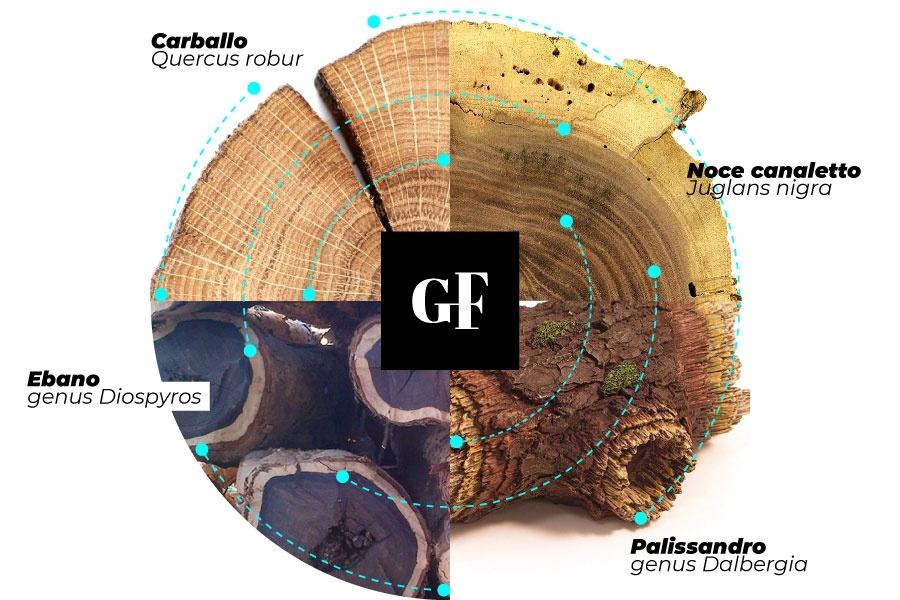
Wood grains, brightness and colors are all elements that determine both the atmosphere of the place according to specific tastes, as well as the functional and stylistic concepts with which it is linked to the rest of the rooms of the house, especially in the case of open spaces.
We therefore offer you a series of considerations and information regarding some of the 15 finishes available in our LESMO WOOD kitchen: one of the protagonists of the LIVING SUPREME catalogue, capable - with its admirable linearity - of celebrating the wood to the highest level, making it a living and distinctive space presence.
EBONY
A wood with a black heart: this is how ebony appears in the tree section. Its naturally dark and deep shade makes it an iconic material with an innate charm that has always seduced designers, architects, craftsmen and refined clients.
Characterized by unique aesthetics and mechanical peculiarities, ebony is obtained from plants of the genus Diospyros, native to India and Indonesia, also widespread in East Africa.
It owes its black tone to a progressive fungal action that dries the lymphatic circulation of the plant: being its typical colour a characteristic that gradually acquires over time, totally black ebony is the most valuable and expensive because it is the type that has the longest "sedimentation".
The same fungal action makes this essence free of porosity, with a hard and compact waterproof mass, also particularly resistant to humidity.
Stable, solid and fascinating, ebony is the ideal wood for a mysterious, intense finish that goes beyond the categories of classic and modern.
CANALETTO WALNUT
The "Canaletto walnut" is the Italian transposition of the American walnut, (its natural habitat is in the forests that run between Canada and Louisiana) also known abroad as Carya and Pecan (a term deriving from the fruit called PECAN WALNUT). Similar to the European walnut, the term "canaletto" describes the radius of channels carrying chlorophyll, well scanned and visible in the section of the tree trunk, which can reach a height of as high as 30 metres.
Imported from North America and used in Europe from the beginning of the 17th century, as a noble and ornamental presence in parks and gardens, today Canaletto walnut is the perfect finish for furniture and veneers: it has a dark natural colour with cinerine gradation and veins capable of creating soft and refined spaces. Its talent is to marry with equal harmony both to the glamorous style and to the most severe minimalism.
ROSEWOOD
Used to build billiard sticks, but also some musical instruments such as the bassoon, the contrabassoon, the marimba, the xylophone, guitars and basses (as well as some components of the violin), rosewood is a wood obtained from some plants of the genus Dalbergia, present in South America, in some areas of Sub-Tropical Africa, India and Indonesia.
Rosewood is a wood with an important history in the furniture sector: already in use in French cabinet-making in the 18th century with the name of "bois de violette" and in England as "rosewood" (in fact due to its typical and natural sweetish scent, an aromatic oil is extracted from this wood which is one of the ingredients of the iconic Chanel N°5 perfume).
The typical shade of rosewood is an intense brown with very well marked squid shaped veins. Extraordinary and at the same time elegant and refined, this wood has often been combined with golden bronzes. Today, design and fashion trends suggest surprising combinations that see rosewood as a protagonist of its beauty combined with technical and contemporary materials.
CARBALLO WOOD
More properly called Quercus robur, the carb is a strong, majestically standing tree which, with its 40 m height, stands out in the forests of Europe, Asia and North America.
The specific Latin name "robur", which in Italian means "strength", has been chosen for this species by Linnaeus (Swedish physician, botanist, naturalist and academic who lived in 1700), as it was used in antiquity by the Romans for designating the oaks and any type of hard wood of great solidity. The wood of this oak is brown-full, very hard, fine-grained, with well marked growth rings, rather heavy and very resistant to water. Always used for barrel staves and for wine and liquor barrels, as in shipbuilding, the strength of this tree is perhaps a property that comes from its impressive longevity: it can exceed 1000 years of life and takes up to forty or fifty years to bloom. So let's prepare to welcome in our house a respectable guest, able to fill our spaces with an evident beauty and full of suggestions.


